• Home
  • /
  • Publications
  • /
  • UN-Habitat & UNCTAD Discussion Paper on Special Economic Zones (SEZs) and Urbanization

UN-Habitat & UNCTAD Discussion Paper on Special Economic Zones (SEZs) and Urbanization


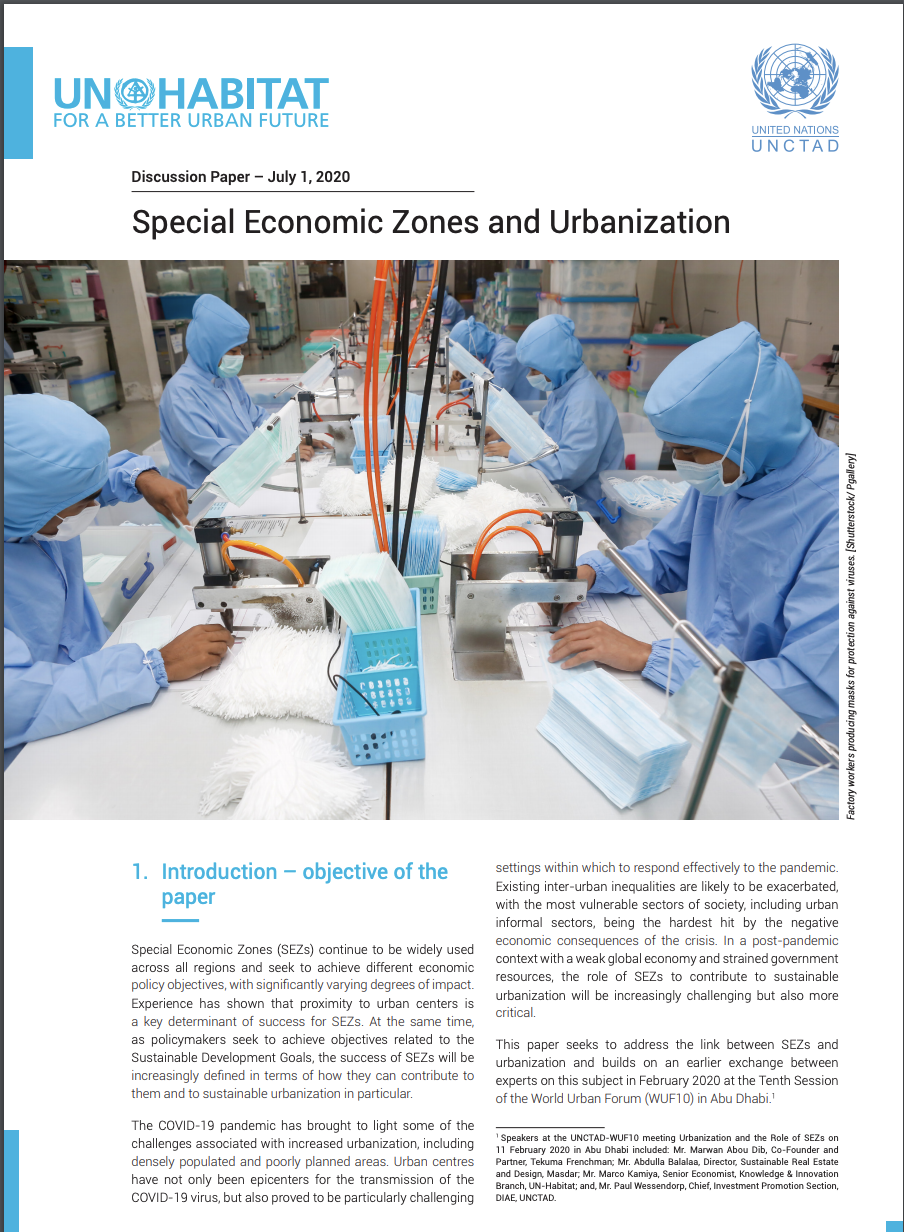
This paper, by UN-Habitat & UNCTAD, seeks to address the link between SEZs and urbanization and builds on an earlier exchange between experts on this subject in February 2020 at the Tenth Session of the World Urban Forum (WUF10) in Abu Dhabi.

Special Economic Zones (SEZs) continue to be widely used across all regions and seek to achieve different economic policy objectives, with significantly varying degrees of impact. Experience has shown that proximity to urban centers is a key determinant of success for SEZs. At the same time, as policymakers seek to achieve objectives related to the Sustainable Development Goals, the success of SEZs will be increasingly defined in terms of how they can contribute to them and to sustainable urbanization in particular.

The COVID-19 pandemic has brought to light some of the challenges associated with increased urbanization, including densely populated and poorly planned areas. Urban centres have not only been epicenters for the transmission of the COVID-19 virus, but also proved to be particularly challenging settings within which to respond effectively to the pandemic.
                       Download PDF.

Existing inter-urban inequalities are likely to be exacerbated, with the most vulnerable sectors of society, including urban informal sectors, being the hardest hit by the negative economic consequences of the crisis. In a post-pandemic context with a weak global economy and strained government resources, the role of SEZs to contribute to sustainable urbanization will be increasingly challenging but also more critical.
Connect with UNOSSC

Stay updated with the latest trends in South-South cooperation and access our vast repository of knowledge.

Copyright © UNOSSC/UNDP

Alliance Application Form

Submit an Expression of Interest and/or Demand Signal. UNOSSC reviews submissions on a rolling basis.

1. Official name of organization / institution / government entity (exclusions to apply) *
Organization logo
Maximum file size: 20 MB
2. Country *
3. Region *
4. Select relevant SDGs *
5. Partner category *
6. Website *
7. Brief description of your institution (max. 150 words) *
Name for the Lead *
Title for the Lead *
Email address for the Lead *
Name for the co-lead
Title for the co-lead
Email address for the co-lead
Section 3. Expression of Interest in the Alliance *
Additional information on proposed areas of engagement may be requested through the platform following initial review by the Alliance Secretariat.
Section 4. Due Diligence and Integrity Declaration *

Submission Note:

  • Submission of this Expression of Interest form does not automatically confer participation in the Alliance.
  • All submissions will be reviewed by the Alliance Secretariat, including basic eligibility screening and proportionate due diligence, as appropriate.
  • Participation in Alliance activities is determined based on relevance to articulated cooperation needs, alignment with Alliance principles, and integrity considerations.
  • Engagement under the Alliance is voluntary, non-binding, and facilitative in nature, and does not constitute funding approval, contractual commitment, or institutional membership.
  • The Alliance Secretariat may contact submitting entities for additional information or clarification during the review process.

Submission of Demand Form

Description of Demand

Indicate the type of support or cooperation requested through the Alliance.
Please briefly describe the challenge, gap, or priority. (Max. 300 words)

Thematic and Geographic Focus

Please indicate the main focus areas of your demand:

A. Thematic Areas (select up to three)
B. Geographic Focus (select all that apply)

Proposed Engagement Modalities

Please indicate how you would like to engage through the Alliance (select all that apply):

Expected Outcomes

Please indicate the main results you seek to achieve through this engagement. (Max. 200 words)
Examples:
• Capacity strengthened
• Partnerships established
• Sectoral or regional strategies co-developed
• Solutions piloted
• Knowledge generated
• Policies informed

Timeline and Readiness (if applicable)

1. Expected timeframe for engagement:
2. Current stage:

Additional Information

Please provide any additional information, documents, or links relevant to this submission.
(Max. 200 words or upload link)

Submission of Offer Form

Description of Contribution

Indicate the type of contribution your institution can provide and describe the expertise, resources, or solutions you may offer.
Please briefly describe your proposed contribution. (Max. 300 words)

Thematic and Geographic Focus

Please indicate the main focus areas of your interest:

A. Thematic Areas (select up to three)
B. Geographic Focus (select all that apply)

Proposed Engagement Modalities

Please indicate how you would like to engage through the Alliance (select all that apply):

Expected Outcomes

Please indicate the main results you aim to achieve through this engagement. (Max. 200 words)
Examples:
• Capacity strengthened
• Partnerships established
• Sectoral or regional strategies co-developed
• Solutions piloted
• Knowledge generated
• Policies informed

Timeline and Readiness (if applicable)

1. Expected timeframe for engagement:
2. Current stage:

Additional Information

Please provide any additional information, documents, or links relevant to this submission.
(Max. 200 words or upload link)

Organization Registration

Authentication & Due Diligence This prototype simulates identity verification, due diligence confirmation, and an authentication step before submission. *

First Name *
Last Name *
Email address *
Password *
Confirm Password *
Name of institution / organization *
Country / Region *
Organization Type *
Organization other *
Function / role *
Organization logo *
Maximum file size: 1 GB

Login

Login / email *
Password *
Remember me

Forgot password?

Connect form

Your name *
Email *
Organization / institution *
Job title / role *
Reason for connecting:
Short message

Create Meeting Room

Purpose:
Use this form to create a virtual meeting room to consult with experts and partners on specific thematic areas. A coordinator will confirm expert availability and meeting details.

Mandatory Information

Meeting purpose / consultation topic *
Type of meeting *
Main thematic area *
SDG (select multiple)
Expert(s) requested from roster
Brief description of discussion *

Preferred meeting date(s) (up to 3)

Date 1
Date 2
Date 3
Preferred time window *
Time zone *
Requesting institution / organization *

Contact person

Name *
Email *

Optional Information

Related Galaxy item
Urgency level *
Preferred language(s)
Other participants to invite
Additional notes

Knowledge Products form

A. Publication Basics (Mandatory)

Exact Title of the Publication *
Executive Summary *
Submitting Organization *
Publication Available Online *
Direct Link to Publication (if online)

B. Publication Details

Subtitle
Publication Type
Year of Publication
Authors / Editors
Key Messages

C. Organizations & Contacts

Partner Organizations

Contact Person

Name
Title
Email

D. Discoverability (Optional)

Topics / Themes
Keywords
SDGs
Geographic Coverage
Language(s)

Good Practices form

SECTION 1. BASIC INFORMATION

Title of the Good Practice *
Name of the Solution(s) *
Short Summary *
max. 60 words
Lead Implementing Institution *
Partner Institutions *
Countries / Territories Involved *
Regions Involved *
Type of Cooperation *

SECTION 2. DEVELOPMENT CONTEXT & SDG ALIGNMENT

Primary SDG(s) Addressed *
SDG Target(s) *
Secondary SDGs (if applicable)
Development Challenge Addressed *
100–150 words

SECTION 3. DESCRIPTION OF THE GOOD PRACTICE & SOLUTION

Objectives of the Good Practice *
max. 100 words
Description of the Solution(s) *
max. 300 words
Innovation Dimension *
max. 150 words

SECTION 4. SOUTH-SOUTH & TRIANGULAR COOPERATION VALUE

South-South Knowledge Exchange *
max. 200 words
Role of Triangular Partners (if applicable)

SECTION 5. PARTICIPATION & GOVERNANCE

Participatory Approach *
max. 150 words
Governance & Institutional Arrangements *

SECTION 6. PRODUCED IMPACT (Partner-Validated)

Description of Produced Impact *
max. 250 words
Quantitative Results *
Qualitative Results
Timeframe of Impact *

SECTION 7. SUSTAINABILITY & SCALABILITY

Sustainability of the Good Practice *
max. 150 words
Replicability & Adaptability of the Solution *
max. 150 words

SECTION 8. RISKS & LESSONS LEARNED

Key Risks and Mitigation Measures
max. 100 words
Lessons Learned *
max. 150 words

SECTION 9. RESOURCES & EVIDENCE

Supporting Materials
Maximum file size: 1 GB
manuals, toolkits, evaluations, media
URL of the Good Practice / Solution

SECTION 10. CONTACT INFORMATION & VALIDATION

Focal Point – Lead Institution

Name *
Title *
Organization *
Email *
Focal Point – Partner Institution (Impact Validation)* (name, title, organization, email) *
Declaration *

Scroll to Top