The Global Peatlands Initiative: Assessing, Measuring and Preserving Peat Carbon

Working to preserve the world’s largest terrestrial organic carbon stock

dianna.kopansky@un.org

Challenges

Peatlands are vital, superpowered ecosystems that capture and store carbon, protect and host biodiversity, control water supply and quality, cool the atmosphere and produce food. Found in almost 170 countries, the international community is only beginning to understand its role in abating climate change. Peatlands cover only 3 percent of the global land area but store 30 percent of the world’s soil carbon. They contain twice as much carbon as the world’s forests. Greenhouse gas (GHG) emissions from drained or degraded peatlands account for 5 to 10 percent of global annual GHG emissions.

Toward a Solution

The Global Peatlands Initiative (GPI), led by the United Nations Environment Programme (UNEP) was launched in 2016 and seeks to develop and adopt new approaches to the conservation, restoration and sustainable management of peatlands, linking science to practice and policymaking. Four peat-rich tropical countries (the Republic of Congo (ROC), the Democratic Republic of Congo (DRC), Indonesia and Peru) are serving as the Initiative’s pilot countries. Over 46 partners have committed to working together to assess, measure and preserve peat carbon and biodiversity, sharing knowledge and experience through a South-South cooperation approach.

We promote healthy peatlands through their restoration and conservation as one of the fastest ways to tackle the climate and nature crisis and help countries to comply with major Multilateral Environmental Agreements (MEAs) and the Nationally Determined Contributions (NDCs) by including goals concerning peatlands to advance progress towards the Sustainable Development Goals (SDGs).

The 2nd Meeting of the GPI Partners in 2017 in Jakarta co-hosted by Indonesia, UNEP and CIFOR gathered governments and specialists to share experience and knowledge culminating in the ‘Peatlands Matter’ Global Landscapes Forum, exploring what it means to employ multidirectional and multi-stakeholder dialogues in practice, adopting a community-first and people-centred approach to peatland management with a strong focus on South-South cooperation, innovation and learning.

The 3rd Meeting of the GPI Partners in 2018 in Brazzaville co-hosted by ROC, DRC and UNEP culminated with Indonesia, ROC and DRC signing the Brazzaville Declaration on Peatlands to protect the Cuvette Centrale region in the Congo Basin from unregulated land use and to prevent the drainage and degradation.

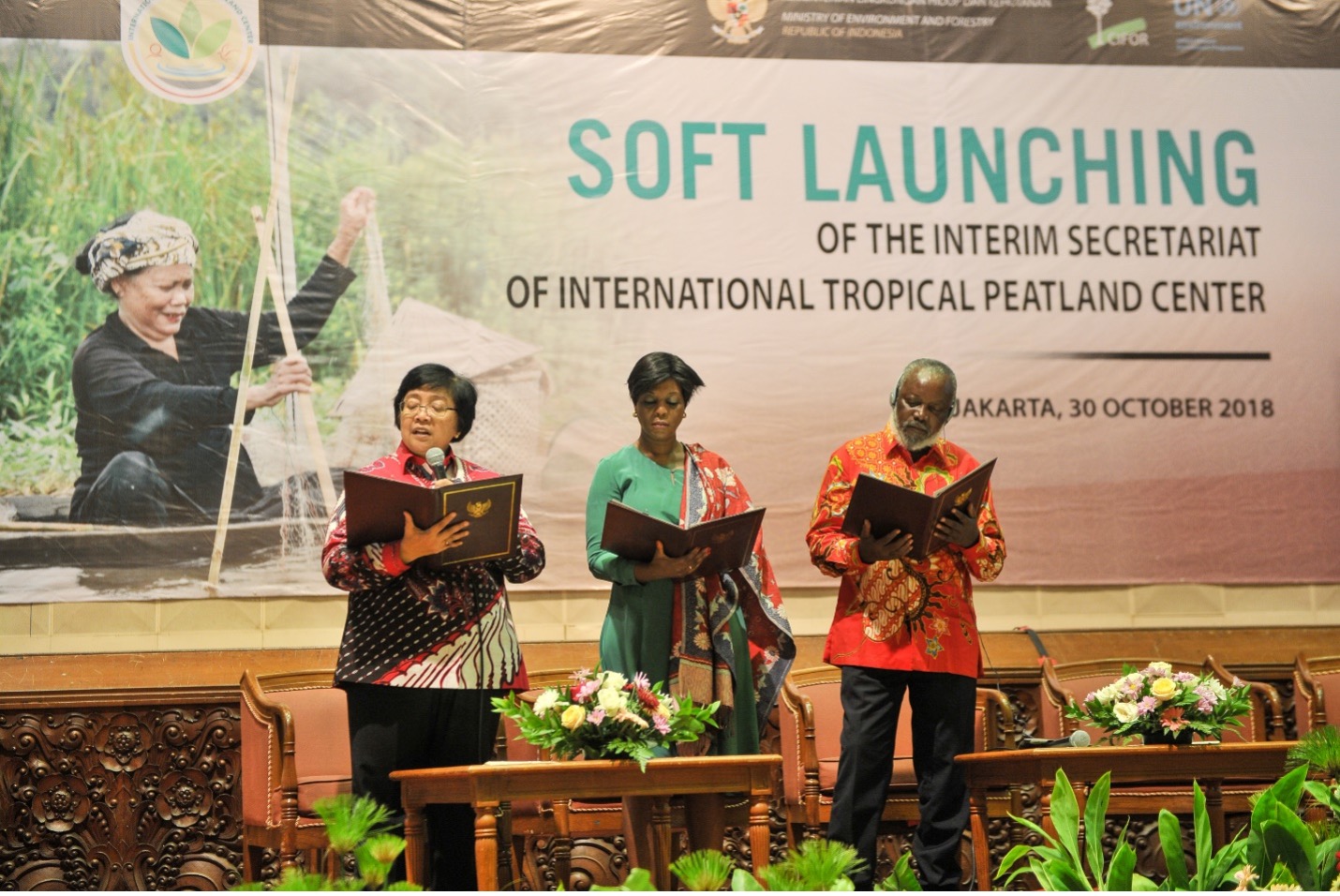
In 2019, implementing the Brazzaville Declaration, Indonesia and UNEP invited ROC, Peru, DRC to a working week to deepen the sharing of peatlands knowledge and to establish the International Tropical Peatland Centre in Bogor. Indonesia and the ROC took their commitment further and signed a Memorandum of Understanding on Peatlands knowledge and experience sharing to solidify further South South collaboration. In 2021, DRC and Peru committed to officially join the ITPC during the High-level Ministerial Dialogue: Peatlands a super nature-based solution, part of the 4th Meeting of the GPI Partners with the official signing to take place in person in Peru in 2022.

The GPI has continued to raise the profile of South-South cooperation on peatlands during a series of global policy-setting events, publications and partnerships. As a significant milestone for GPI, during UNEA4, all countries adopted the first ever global resolution on the conservation and sustainable management of peatlands. [1]

At COP26 in Scotland, GPI and partners held the first-ever Global Peatlands Pavilion with 45 events physically and online featuring 250 speakers with over 2700 people from 100 countries registered online. The pavilion also launched the GPI 3D Virtual Peatlands Pavilion and sessions are on the GPI Youtube channel .

South-South and triangular cooperation are the primary delivery mechanisms of the Global Peatlands Initiative. This approach has facilitated the identification, collection and sharing of good practices. It has enabled exchanges, improved methods and promoted the adoption of approaches that support sustainable peatland management. Exchanges between countries in the global South have allowed stakeholders to make bold decisions, accelerate commitments to action and establish a coalition of like-minded actors to structure their collaboration.

[1] UNEP/EA.4/RES.16

Primary SDG
CONTACT INFORMATION
Ms. Dianna Kopansky, Programme Management Officer and Global Peatlands Coordinator, United Nations Environment Programme (UNEP)
COUNTRIES INVOLVED
Congo, Democratic Republic of the Congo, Indonesia, Peru
SUPPORTED BY
46 partners, which can be found on the Initiative’s website

Similar Solutions


  • All Post
  • ATCT Featured Publications POM
  • BAPA+40
  • Blog
  • Capacity Development Initiatives
  • CICETE Featured Publications POM
  • CIKD
  • Cities Clusters - Agriculture
  • Cities Clusters - COVID-19
  • Cities Clusters - COVID-19 Knowledge Products
  • Cities Clusters - DRR
  • Cities Clusters - E-commerce
  • Cities Clusters - Tourism
  • Cities Clusters - Tourism Knowledge Products
  • Cities Clusters - Transport
  • Cities Clusters - Waste
  • Cities Project
  • Cities Project COVID-19 Newsletters
  • Cities Project COVID-19 Response
  • Cities Project Knowledge Products
  • Classic (untouched)
  • Climate Action
  • COMSATS Featured Publications POM
  • COMSATS Featured Solutions POM
  • Converted from Divi
  • Converted from Mixed
  • Converted from WPBakery
  • COVID-19
  • COVID-19 Page Featured Solutions
  • DRR Knowledge Products
  • DRR News
  • Empty Post
  • Events
  • Featured Event UN-Habitat POM
  • Financing for Development
  • Financing Mechanisms
  • g7+
  • Gender Events
  • Gender News
  • Good Practices in SSTrC Series
  • Good Practices Publications
  • Good Practices Thematic Series & Special Editions
  • Good Practices Vol. 2
  • Good Practices Vol. 3
  • GSSDC
  • Highlighted
  • Highlighted Publications
  • IAEA Featured Solutions POM
  • IBRAF Featured Publications POM
  • IBSA Fund
  • IBSA Fund Annual Reports
  • IBSA Fund News and Stories
  • IBSA Fund Publication
  • IBSA Fund Story
  • ICGEB Featured Events POM
  • ICGEB Featured Publications POM
  • ICGEB Featured Solutions POM
  • ILO Featured Events POM
  • ILO Featured Publications POM
  • ILO Featured Solutions POM
  • India-UN Development Partnership Fund
  • India-UN Fund Publication
  • India-UN Fund Story
  • IsDB
  • IsDB Featured Publications POM
  • IsDB SCC
  • News
  • Norec Featured Publications POM
  • Norec Featured Solutions POM
  • Peace and Development
  • PGTF Publications
  • PGTF Story
  • PICA Featured News POM
  • PICA Featured Publications POM
  • PICA Featured Solutions POM
  • PIDF Featured Publications POM
  • Publications
  • Regional Updates
  • Research
  • ROK-UNOSSC Facility
  • SGP Featured Publication POM
  • SGP Featured Solutions POM
  • Solution
  • South South in Action
  • South-South Global Thinkers
  • South-South Ideas
  • South-South Ideas Series
  • South-South in Action Series
  • Southern Response to COVID-19
  • SSN4PSI Featured Publications POM
  • SSN4PSI Featured Solutions POM
  • Training
  • UN Day for SSC 2020
  • UN Fund for SSC
  • UN SSC Day Publications
  • UN-Habitat Featured Publications POM
  • UN-HABITAT Featured Solutions POM
  • UNCCT
  • UNEP Featured Publications POM
  • UNFPA
  • UNFSSC Publication
  • UNFSSC Story
  • UNIDO Featured Publications POM
  • UNIDO Featured Solutions POM
  • UNIDO POM Events
  • UNOCT Featured Publications POM
  • UNV
  • UNV Featured Publications POM
  • WB Featured Publications POM
  • WB Featured Solutions POM
  • Webinars
  • WFP Featured Events POM
  • WFP Featured Publication POM
  • WFP Featured Solutions POM
  • WIPO
  • Workshops and Seminars
  • Youth4South
  • z Across the Globe 1
  • z Across the Globe 2
  • z Across the Globe 4
  • z Across the Globe 5
  • z Across the Globe 6
  • z Across the Globe 7
  • z Across the Globe 8
  • z ES BAPA+40
  • z ES Eventos
  • z ES Noticias
  • z ES Noticias Destacadas
  • z ES Publicaciones
  • z ES Publicaciones Destacadas
  • z ES Serie Buenas Prácticas en la CSSyT
  • z ES Serie El Sur-Sur en Acción
  • z FR Actualités
  • z FR BAPA+40
  • z FR Événements
  • z FR Publications
  • z FR Publications en vedette
  • z FR Série Bonnes pratiques en CSST
  • z FR Série Sud-Sud en action
  • z Highlighted News
  • z Photos
  • z Videos
  • z ZH BAPA+40
  • z ZH Events
  • z ZH News

Connect with UNOSSC

Stay updated with the latest trends in South-South cooperation and access our vast repository of knowledge.

Copyright © UNOSSC/UNDP

Alliance Application Form

Submit an Expression of Interest and/or Demand Signal. UNOSSC reviews submissions on a rolling basis.

1. Official name of organization / institution / government entity (exclusions to apply) *
Organization logo
Maximum file size: 20 MB
2. Country *
3. Region *
4. Select relevant SDGs *
5. Partner category *
6. Website *
7. Brief description of your institution (max. 150 words) *
Name for the Lead *
Title for the Lead *
Email address for the Lead *
Name for the co-lead
Title for the co-lead
Email address for the co-lead
Section 3. Expression of Interest in the Alliance *
Additional information on proposed areas of engagement may be requested through the platform following initial review by the Alliance Secretariat.
Section 4. Due Diligence and Integrity Declaration *

Submission Note:

  • Submission of this Expression of Interest form does not automatically confer participation in the Alliance.
  • All submissions will be reviewed by the Alliance Secretariat, including basic eligibility screening and proportionate due diligence, as appropriate.
  • Participation in Alliance activities is determined based on relevance to articulated cooperation needs, alignment with Alliance principles, and integrity considerations.
  • Engagement under the Alliance is voluntary, non-binding, and facilitative in nature, and does not constitute funding approval, contractual commitment, or institutional membership.
  • The Alliance Secretariat may contact submitting entities for additional information or clarification during the review process.

Submission of Demand Form

Description of Demand

Indicate the type of support or cooperation requested through the Alliance.
Please briefly describe the challenge, gap, or priority. (Max. 300 words)

Thematic and Geographic Focus

Please indicate the main focus areas of your demand:

A. Thematic Areas (select up to three)
B. Geographic Focus (select all that apply)

Proposed Engagement Modalities

Please indicate how you would like to engage through the Alliance (select all that apply):

Expected Outcomes

Please indicate the main results you seek to achieve through this engagement. (Max. 200 words)
Examples:
• Capacity strengthened
• Partnerships established
• Sectoral or regional strategies co-developed
• Solutions piloted
• Knowledge generated
• Policies informed

Timeline and Readiness (if applicable)

1. Expected timeframe for engagement:
2. Current stage:

Additional Information

Please provide any additional information, documents, or links relevant to this submission.
(Max. 200 words or upload link)

Submission of Offer Form

Description of Contribution

Indicate the type of contribution your institution can provide and describe the expertise, resources, or solutions you may offer.
Please briefly describe your proposed contribution. (Max. 300 words)

Thematic and Geographic Focus

Please indicate the main focus areas of your interest:

A. Thematic Areas (select up to three)
B. Geographic Focus (select all that apply)

Proposed Engagement Modalities

Please indicate how you would like to engage through the Alliance (select all that apply):

Expected Outcomes

Please indicate the main results you aim to achieve through this engagement. (Max. 200 words)
Examples:
• Capacity strengthened
• Partnerships established
• Sectoral or regional strategies co-developed
• Solutions piloted
• Knowledge generated
• Policies informed

Timeline and Readiness (if applicable)

1. Expected timeframe for engagement:
2. Current stage:

Additional Information

Please provide any additional information, documents, or links relevant to this submission.
(Max. 200 words or upload link)

Organization Registration

Authentication & Due Diligence This prototype simulates identity verification, due diligence confirmation, and an authentication step before submission. *

First Name *
Last Name *
Email address *
Password *
Confirm Password *
Name of institution / organization *
Country / Region *
Organization Type *
Organization other *
Function / role *
Organization logo *
Maximum file size: 1 GB

Login

Login / email *
Password *
Remember me

Forgot password?

Connect form

Your name *
Email *
Organization / institution *
Job title / role *
Reason for connecting:
Short message

Create Meeting Room

Purpose:
Use this form to create a virtual meeting room to consult with experts and partners on specific thematic areas. A coordinator will confirm expert availability and meeting details.

Mandatory Information

Meeting purpose / consultation topic *
Type of meeting *
Main thematic area *
SDG (select multiple)
Expert(s) requested from roster
Brief description of discussion *

Preferred meeting date(s) (up to 3)

Date 1
Date 2
Date 3
Preferred time window *
Time zone *
Requesting institution / organization *

Contact person

Name *
Email *

Optional Information

Related Galaxy item
Urgency level *
Preferred language(s)
Other participants to invite
Additional notes
Scroll to Top