
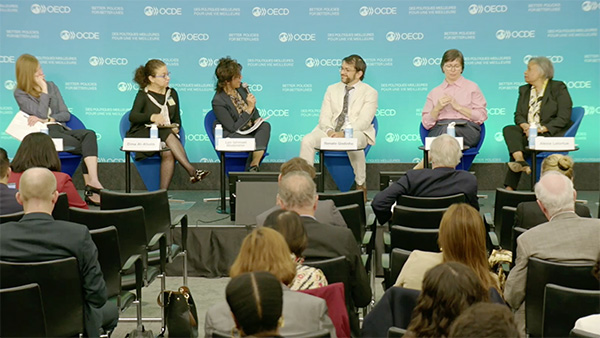
At a high-level OECD panel, UNOSSC Director Dima Al-Khatib called for a more connected, country-driven partnership architecture that places the Global South at the centre of decision-making.
Convened as part of the OECD Conference: Future of Development Co-operation, the high-level session “Resetting Partnerships for Global Development Progress” brought together leaders from governments, international organizations and cooperation platforms to examine how partnerships can evolve in response to a rapidly changing global landscape.
Discussions focused on a central question: how can development cooperation remain effective, equitable and responsive at a time of mounting challenges, shifting geopolitical dynamics and growing pressure on development financing?
Opening the session, H.E. Stine Håheim, State Secretary to Norway’s Minister of International Development, described a pivotal moment for the development system. Extreme poverty, climate shocks, conflict, humanitarian needs, rising debt burdens and shrinking assistance, she said, are converging at a time when global solutions are most needed. Yet the willingness and resources to invest in collective action are under increasing pressure.
Calling for clearer purpose, stronger country ownership and more effective use of scarce resources, she stressed that development cooperation must remain anchored in its core mission: supporting sustainable development, reducing poverty and expanding opportunities for all.
Moderated by Ambassador Dr. Len Ishmael, Senior Fellow at the Policy Center for the New South, the discussion explored broad shifts reshaping international cooperation. Participants reflected on the rise of new actors, the growing agency of developing countries, evolving approaches to partnership and the need to rebalance decision-making across the development landscape.
Dima Al-Khatib, Director of the United Nations Office for South-South Cooperation (UNOSSC), underscored the growing relevance of South-South and triangular cooperation in an increasingly interconnected world. Responding to a question on how South-South cooperation fits into today’s evolving partnership landscape, Director Al-Khatib noted that many of the ideas highlighted throughout the conference – including co-design, capacity-building, institutional strengthening, mutual learning and country ownership – have long been central principles of South-South and triangular cooperation.
“What is changing is the context,” Director Al-Khatib noted, emphasizing that countries of the Global South increasingly participate not only in implementation but also in shaping priorities, designing solutions and driving decision-making processes. Partnerships, she argued, must evolve accordingly. For UNOSSC, this shift is reflected in its new Strategic Framework (2026-2029), which places emphasis on understanding emerging trends, responding to country priorities and broadening engagement across the development ecosystem.
Director Al-Khatib highlighted the forthcoming Global Alliance for South-South and Triangular Cooperation as an important step in that direction. Designed as a platform to connect countries with expertise, partnerships and catalytic support, the initiative aims to bring together governments, multilateral development banks, international financial institutions, the private sector and other stakeholders around shared development objectives. In a context where resources may exist but countries often face constraints in accessing them, she emphasized the important role that multilateral institutions can play in facilitating connections between development needs, available solutions and financing opportunities. Resetting partnerships, Director Al-Khatib suggested, is not simply about adopting new terminology or creating new mechanisms. It is about building stronger connections between demand, expertise and resources, while ensuring that cooperation remains responsive to country priorities.
Looking ahead, Director Al-Khatib called for a transition to a more connected global cooperation infrastructure – one capable of linking needs, solutions and financing more effectively. Achieving this, she said, will require political commitment, investment in shared platforms, interoperability, transparency, accountability and trust.
Other speakers reinforced many of these themes from different perspectives.
Cindy Termorshuizen, Deputy Minister of International Development of Canada, stressed that multilateral cooperation remains indispensable but must become more focused, agile and responsive to contemporary realities. She emphasized the importance of demonstrating tangible results while maintaining public support for international cooperation.
Renato Godinho, Director of the Support Mechanism of the Global Alliance Against Hunger and Poverty, argued that efforts to reduce hunger and poverty remain a shared global interest. He cautioned against overly transactional approaches to cooperation and called for changes not only in programming but also in the systems and processes that shape development partnerships.
Mariin Ratnik, Undersecretary of Economic and Development Affairs of Estonia, highlighted the value of co-creation, mutual learning and country ownership. Drawing on Estonia’s experience, she emphasized the transformative potential of digitalization and the importance of tailoring cooperation to national priorities and comparative advantages.
Alexia Latortue, Head of Secretariat of the Future of Development Co-operation Coalition, described the current moment as an opportunity to rethink how development cooperation is conceived and delivered. She advocated for a broader perspective that extends beyond aid to encompass domestic resources, trade, technology, innovation, entrepreneurship and state capacity, while placing countries firmly at the centre of their own development trajectories.
Across the discussion, a common theme emerged: effective partnerships require more than financial resources alone. They depend on trust, shared responsibility, country leadership and the ability to adapt to changing realities.
For UNOSSC, the conversation reaffirmed the growing importance of South-South and triangular cooperation as mechanisms for fostering mutual learning, mobilizing partnerships and advancing country-led solutions. As global development challenges become increasingly interconnected, the need for more inclusive, responsive and collaborative approaches to cooperation is becoming ever more evident.